
Experience the Moon Landings as if You Were There
Relive the historic Moon landings in Once Upon the Moon. Through the astronauts’ own stories, authentic film footage and photographs from the Apollo missions, and scientific data, you will experience the moments that changed history in an entirely new way.
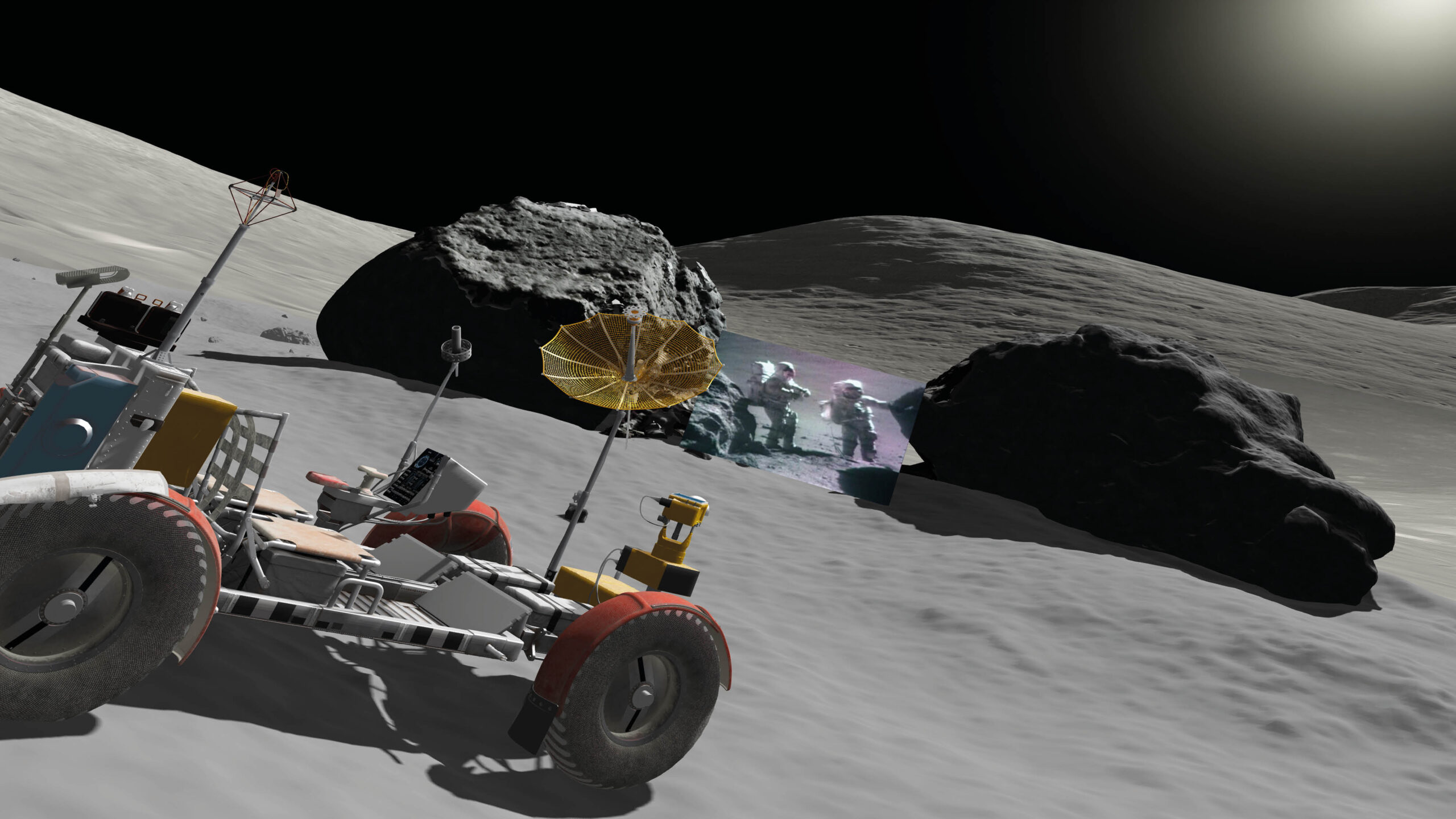
In the immersive dome format, historical photographs and films are placed exactly where they were once captured on the lunar surface. The result is a visual and scientific time capsule in which the Moon landings are not merely shown, but truly experienced.
The film features Apollo astronauts Charlie Duke and Harrison Schmitt — two of the twelve people who have walked on the Moon. The story is also connected to today’s and tomorrow’s lunar exploration through interviews with a new generation of scientists and astronauts, including Christina Koch, who participated in the first crewed Artemis mission, and Swedish astronaut Marcus Wandt.
Once Upon the Moon is the story of humanity’s first steps on the Moon — and of the people, images, and discoveries that forever changed our view of the world.
Pricing
| Adults | 120 kr | 349 kr |
| Senior/student | 85 kr | 249 kr |
| Children 4-17 years | 80 kr | 199 kr |
| Children 0-3 years | Gratis | Gratis |
* The annual pass includes, among other things, unlimited regular films & screenings in the Dome for a whole year, 10% discount in the store and 10% discount in Restaurant & Café C. Read more about what is included and the conditions here.
Information
Running time: 42 minutes
Language: Swedish, English*
Recommended age: 10 years and up
Presented in: 3D
Produced by: Visualiseringscenter C
*Audio tracks are available via translation headsets, which can be booked at the reception desk and collected upon entering the dome theatre.
The performance contains strong visual effects, sound, and lighting.
About the Production
Once Upon the Moon is an 8K fulldome 3D show in which audiences step into humanity’s first journeys to the Moon. The film was produced within WISDOME by Visualiseringscenter C and Linköping University as part of the guest professorship program Peter Wallenberg Jr Visual Science Communication, with support from the Hasselblad Foundation and the Knut and Alice Wallenberg Foundation. A central part of the historical imagery was photographed using Hasselblad cameras.
Q&A
Watching a film in 3D means that your brain perceives depth in the image even though it isn’t really there. To experience the 3D effect, you need a pair of 3D glasses, which we provide for all visitors. Thanks to 3D, you get the feeling that objects are floating in the air in front of you.
It works perfectly fine to wear the 3D glasses over your regular glasses.
The show is presented with Swedish narration. An English-language version is also available, and visitors who would like the English version can borrow headphones on site.
The content of this show is intended for a general audience, and for families a minimum recommended age of 10 years is advised.
Absolutely. We have designated spaces for wheelchairs and walkers at the top of the dome theater.
Behind the Scenes with the Production Team
How did the idea for Once Upon the Moon emerge?
Once Upon the Moon is an idea that director Carter Emmart has carried with him for decades. During his time as a guest professor at Visualiseringscenter C and Linköping University, he developed the project within the framework of the Peter Wallenberg Jr Guest Professorship in Visual Science Communication. Carter, formerly Head of Astrovisualization at the American Museum of Natural History and Hayden Planetarium, is considered one of the world’s leading dome film directors and has long collaborated closely with Professor Anders Ynnerman, Visualiseringscenter C, and Linköping University — not least as one of the visionaries behind the OpenSpace software.
The vision behind Once Upon the Moon is to allow audiences to relive humanity’s journeys to the Moon during the Apollo program through the immersive dome format. By contextualizing historical images and footage with data-driven visualizations and interviews, the production seeks to create a powerful sense of what it was actually like to travel to and live on the Moon.
The goal is not only to portray the technological and human achievements behind the Moon landings, but also to explain why humanity went there, what was learned during the Apollo program, and why future lunar missions still matter. At the same time, the production aims to introduce a new generation to this era and highlight the enormous scientific and engineering advances made possible through lunar exploration.
How was this production created?
Large parts of Once Upon the Moon were produced using the research software OpenSpace, developed at Linköping University and Visualiseringscenter C in collaboration with institutions including the American Museum of Natural History and the University of Utah. OpenSpace is used both by researchers to visualize astronomical data and by planetariums and dome theatres around the world for live presentations that help audiences explore and understand the universe.
In the production, the team worked with data-driven visualization, high precision, and scientific accuracy to create as authentic an experience as possible. At the same time, the software was used in new and innovative ways. Data from the Lunar Reconnaissance Orbiter, which has mapped the Moon’s surface in great detail, was combined with information about the astronauts’ movements during the Apollo missions. This made it possible to recreate their routes directly on visualizations of the lunar landscape.
Images and footage from the Moon missions were also mapped precisely onto the actual terrain of the lunar surface, allowing viewers to see exactly where and in what environment the material was recorded. The result is a form of “mixed reality,” where historical archive material merges with modern scientific visualization. This creates a broader perspective — both literally and figuratively — on the Apollo program and gives audiences a stronger sense of scale, distance, and the real environment experienced by the astronauts.
Which astronauts appear in Once Upon the Moon?
During the pre-production phase of Once Upon the Moon, the team interviewed both astronauts and scientists to give the story a personal and scientifically grounded perspective. Among those interviewed were Apollo astronauts Charlie Duke and Harrison Schmitt, two of the twelve people who have walked on the Moon.
Charlie Duke participated in Apollo 16 and spent more than 20 hours on the lunar surface, much of that time exploring with the lunar rover. During the interviews, the astronauts were shown visual material used in the production, which triggered vivid memories and many personal stories from their missions and experiences on the Moon.
The second Apollo astronaut interviewed was Harrison “Jack” Schmitt, who participated in Apollo 17 — the sixth and final Moon landing of the Apollo program. Schmitt is the only scientist and geologist to have traveled to the Moon, and his expertise contributed deeper perspectives on lunar geology and the scientific discoveries made during the missions. His stories also highlight how the Moon’s geological history is closely connected to the evolution of Earth itself.
The production also connects to present and future lunar exploration through interviews with astronauts from a new generation. One of them is Christina Koch, who recently returned from the first crewed Artemis mission. She represents a new era of human spaceflight that is paving the way for future journeys to the Moon. In the interviews, she reflects on why humanity should return there and what significance upcoming lunar missions may have for science and exploration.
Swedish astronaut Marcus Wandt, who traveled to the International Space Station in 2024, also appears in the project. Wandt represents the new generation of astronauts and contributes perspectives on today’s space research and the future of international cooperation in space.
In addition to the astronauts, the production team interviewed researchers and experts who contributed to the scientific content in OpenSpace and to the development of the production itself. In this way, personal stories are interwoven with current research and data-driven visualization to create an experience that is both emotional and scientifically grounded.